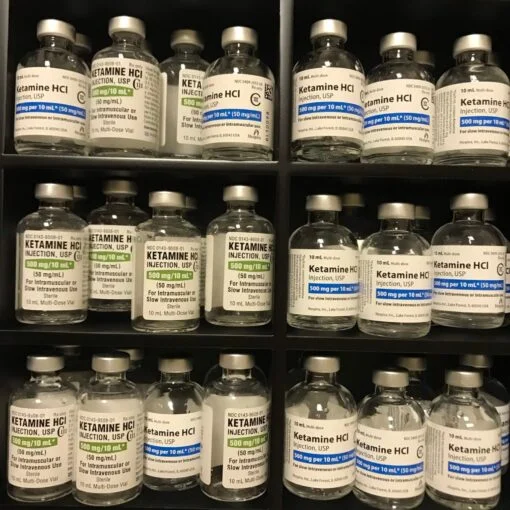
Liquid ketamine refers to ketamine presented in a liquid formulation, most commonly encountered in clinical, hospital, and research environments. In the United Kingdom, liquid ketamine is primarily discussed within medical education, pharmaceutical science, and regulatory studies as an example of a controlled drug that plays a legitimate role in healthcare while being subject to strict legal oversight. This description is intended solely to support learning and informed discussion in an academic or professional context.
Ketamine is a synthetic compound developed in the 1960s during research into safer anesthetic agents. Chemically classified as an arylcyclohexylamine, it is widely recognised in medical and scientific literature for its dissociative anesthetic properties. In educational settings, ketamine is often studied for its mechanism of action as an antagonist of the N-methyl-D-aspartate (NMDA) receptor, a key component of excitatory neurotransmission in the central nervous system. This mechanism helps explain ketamine’s effects on pain perception, consciousness, and sensory processing.
In liquid form, ketamine is typically presented as a solution suitable for controlled clinical or research use. From a pharmaceutical education perspective, liquid ketamine provides a clear example of how formulation affects drug stability, storage, and administration within regulated healthcare systems. Liquid preparations allow precise measurement and controlled delivery in professional settings, which is why they are commonly referenced in hospital pharmacy and anesthesiology training in the UK.
Within UK medical education, liquid ketamine is most often discussed in relation to anesthesia, emergency medicine, and pain management. Historically, it has been valued for its ability to provide analgesia and anesthesia while preserving airway reflexes, a characteristic that has made it particularly relevant in emergency and trauma care. These clinical attributes are explored in textbooks and training programmes to help students understand how different anesthetic agents are selected based on patient needs and clinical context.
Liquid ketamine is also relevant to contemporary research discussions in the UK, particularly in neuroscience and psychiatry education. Academic studies have investigated ketamine’s effects on brain signalling pathways and neuroplasticity, contributing to broader scientific conversations about mood disorders and novel therapeutic approaches. In educational materials, liquid formulations are referenced to explain how controlled delivery systems are used in clinical trials and hospital-based research, always under strict ethical and regulatory approval.
A crucial aspect of any UK-focused educational description of liquid ketamine is its legal and regulatory status. In the United Kingdom, ketamine is classified as a controlled drug, meaning its manufacture, possession, supply, and use are regulated by law. Liquid ketamine is therefore restricted to authorised medical, veterinary, and research contexts. Understanding this regulatory framework is an essential part of education in medicine, pharmacy, nursing, and biomedical sciences, reinforcing the importance of compliance, documentation, and professional accountability.
In pharmacy education, liquid ketamine is used as a case study to illustrate controlled drug management within the NHS and other licensed healthcare settings. Topics such as secure storage, record-keeping, prescribing authority, and audit procedures are often taught using controlled medicines like ketamine as examples. These discussions highlight how pharmaceutical governance protects patient safety while enabling legitimate clinical use.
From a formulation science standpoint, liquid ketamine demonstrates principles of solution chemistry, including solubility, concentration control, and stability. Students learn how liquid pharmaceutical products are designed to remain chemically stable over defined periods and how environmental factors such as light and temperature can affect solution integrity. These lessons are fundamental to pharmaceutical science and quality assurance training in the UK.
Liquid ketamine also appears in interdisciplinary educational discussions that examine public health and societal impact. In the UK, ketamine has been the subject of both medical innovation and public health concern, making it a useful example for exploring how substances can have dual identities depending on context. Educational programmes use such examples to encourage critical thinking about drug policy, harm reduction, and the balance between access for medical benefit and prevention of misuse.
It is equally important to distinguish between educational reference and practical guidance. In academic and informational materials, liquid ketamine is discussed conceptually rather than operationally. No instructions for preparation, administration, or personal use are provided, and emphasis is placed on professional training and legal authorisation. This approach reflects best practice in UK science and health education, where responsibility and ethics are core components of curriculum design.
In summary, liquid ketamine serves as an important educational reference within the UK for understanding anesthetic pharmacology, pharmaceutical formulation, and controlled drug regulation. Its study helps illustrate how chemistry, medicine, law, and ethics intersect in modern healthcare systems. When examined in an academic or professional framework, liquid ketamine contributes to a deeper understanding of drug development, clinical practice, and regulatory responsibility. This description is intended for informational purposes only and does not promote acquisition or use outside of legitimate, licensed, and regulated environments.


Reviews
There are no reviews yet.